The Menorah of Hope
A monument of light forged from war
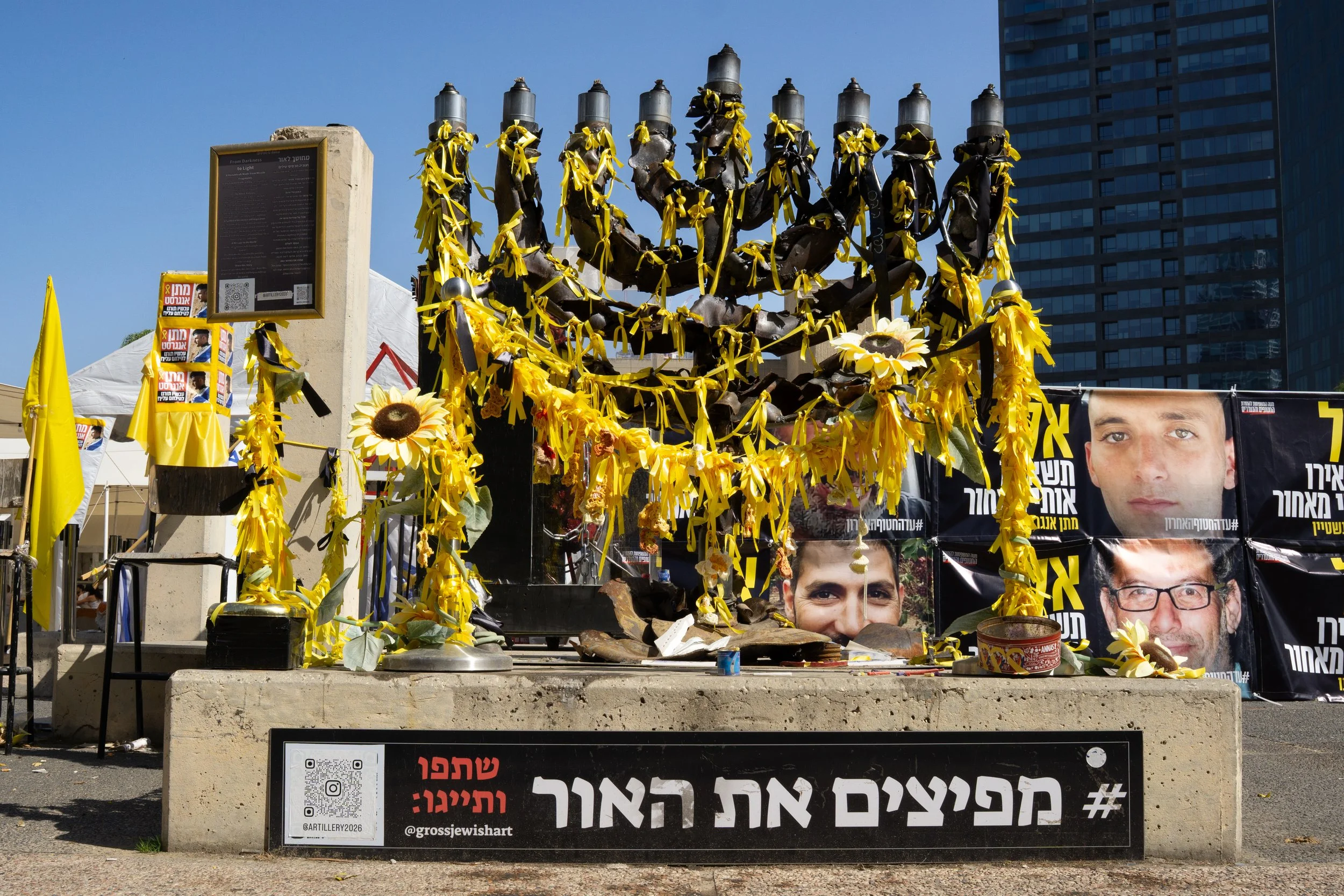
Photo: Lilia Megera
The Menorah of Hope is a large scale sculptural installation by Israeli artist Eli Gross. Created from missile fragments launched at Israel during the Iron Swords War, the Menorah was first installed in Hostages Square in Tel Aviv in December 2024 and rapidly became one of the defining visual symbols of the period. It functions simultaneously as an artwork, a public memorial, and a living site of collective memory.
Constructed from remnants of missiles fired from Iran, Gaza, and Lebanon, alongside components of Iron Dome interceptors, the material of the Menorah originates in instruments designed for destruction. Through a deliberate process of heating, shaping, and reconstruction, these fragments were transformed into the form of a traditional Jewish menorah. The act of conversion is central to the Menorah. Weapons intended to extinguish life are reconfigured into a structure dedicated to illumination, faith, and continuity.
The Menorah stands nearly two meters tall and weighs approximately half a ton. During Hanukkah 5785 (2024), thousands of visitors tied yellow ribbons around its branches as a gesture of solidarity and prayer for the return of the hostages. Later, white ribbons were added to mark the joy of those who returned alive. The public physically inscribed their grief and hope into the Menorah, allowing it to absorb the emotional imprint of a nation.
Candle lighting ceremonies were held around the Menorah with families of hostages, wounded soldiers, and public figures. For many visitors, the Menorah became a space where confrontation with loss coexisted with an insistence on light. During one of the most difficult chapters in the country’s history, it offered a visible language of resilience.
Personal history as artistic foundation
The Menorah of Hope is inseparable from the biography of its creator. Eli Gross was born into a Hasidic family in Jerusalem and raised within a cultural framework shaped by memory, ritual, and communal responsibility. His early adult life led him into the technology sector, but the outbreak of war marked a decisive turning point.
Gross served more than four hundred days in reserve duty in a technological unit of the Israeli Air Force. His sustained exposure to the material reality of conflict gradually evolved into an artistic vocabulary. Where others saw debris, he recognized charged matter carrying historical weight. Missile fragments became not remnants of violence but carriers of narrative.
His practice centers on the fusion of contemporary conflict materials with ancient Jewish symbols, creating a dialogue between immediate history and long civilizational memory. The Menorah of Hope represents the culmination of this trajectory. It binds a ritual object rooted in millennia of tradition to the raw physical residue of the present moment. For Gross, the Menorah is not merely an exhibition piece. It is a process of transformation through which personal experience becomes collective expression.
Documented public history
The Menorah of Hope is formally recorded across journalistic, civic, and diplomatic archives. Its trajectory is embedded in public documentation as much as in exhibition history.
The Menorah was placed in Hostages Square in December 2024 in the context of the Iranian attack on Israel in October 2024 and the Iron Swords War. It was constructed from missile fragments launched from three fronts and incorporated Iron Dome components. None of the missiles caused casualties. The Menorah was conceived as a symbol of resilience, hope, and the belief in light emerging from destruction.
During Hanukkah 5785, thousands of visitors tied yellow ribbons around the branches as a sign of solidarity and prayer. Later, white ribbons marked the joy of returned hostages. The Menorah became a pilgrimage site and a symbol of hope during one of the most difficult periods in the country’s history.
Throughout the following year the Menorah remained in Hostages Square, appeared at major public events including the historic Vitkoff speech, and was viewed by hundreds of thousands of visitors and tens of millions through media coverage and social networks.
The symbolism of the Menorah expresses the transformation of destructive material into a message of life, faith, and national endurance. It is widely regarded as one of the most recognizable emblems associated with Hostages Square and with the spirit of unity that followed the war.
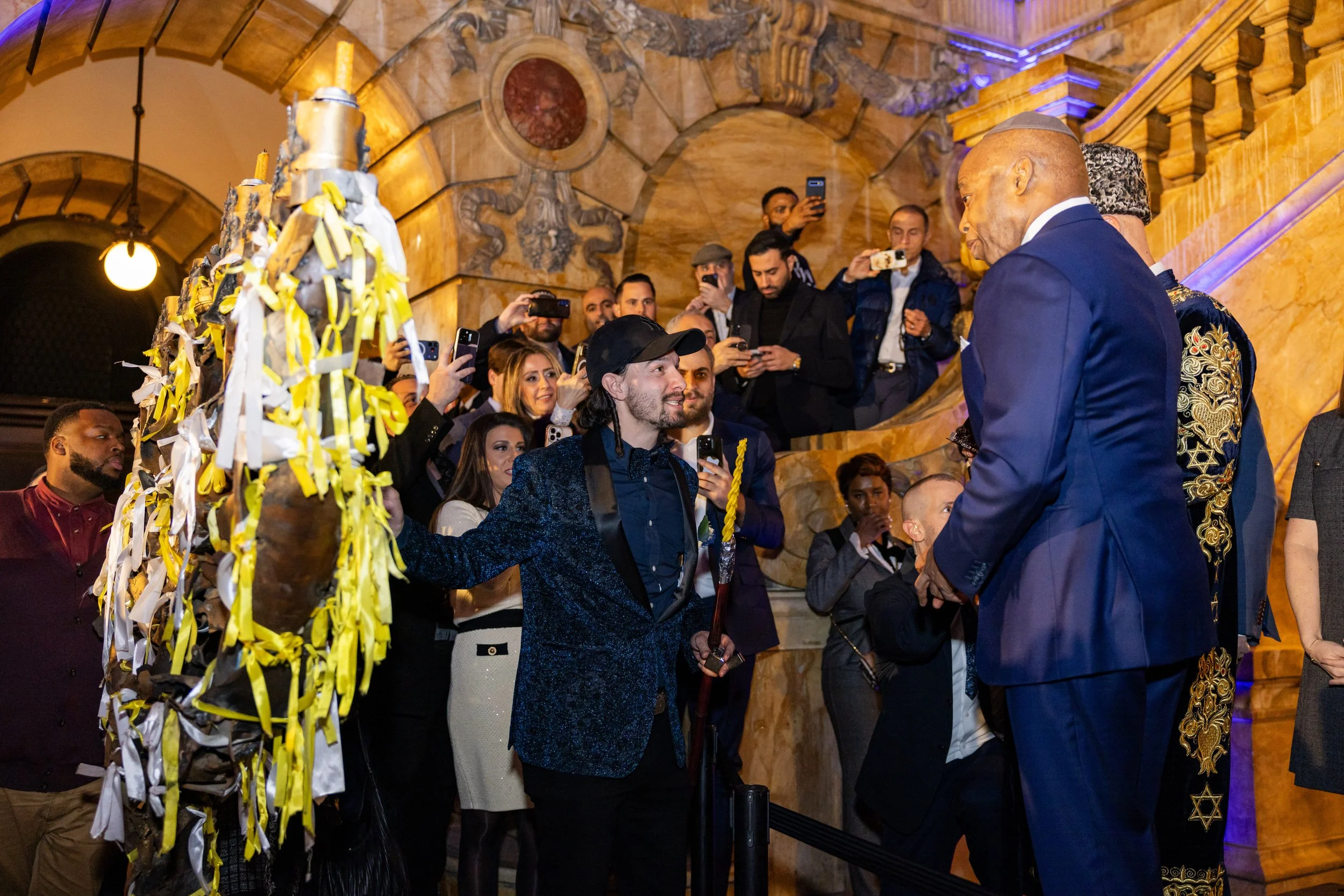
Ahead of Hanukkah 5786, the Menorah was transported to the United States via diplomatic mail with the assistance of the Israeli Ministry of Foreign Affairs and the Embassy of Israel in the United States. It entered a ceremonial tour across New York City intended to bring light and solidarity to Jewish communities in the diaspora.
The Menorah was lit at an official Hanukkah celebration hosted by the City of New York at City Hall by outgoing Mayor Eric Adams. It was also lit outside United Nations headquarters in a ceremony led by Israel’s Ambassador to the UN, Danny Danon, together with Shira Gvili, sister of Ran Gvili, in a public prayer for his return.
Additional lightings took place in TriBeCa Synagogue in Manhattan, the Syrian Jewish community in New York, a Hasidic community in Borough Park, and a community in Crown Heights.
Exhibition 1956
A convergence of exile, homeland, and memory
A journey spanning thousands of years of a wandering people finds a point of convergence in a solo exhibition in Manhattan.
In this exhibition Eli Gross presents a personal trajectory that begins in a Hasidic household in Jerusalem, passes through prolonged reserve military service during a national war, and culminates in the creation of the Menorah of Hope. The Menorah and the surrounding works function as material witnesses. Each fragment carries history, and each structure negotiates the relationship between destruction and survival.
The exhibition explores identity, memory, resilience, and continuity. Through sculpture and installation, past and present collapse into a shared spatial field where exile and homeland coexist. The Menorah of Hope stands at the center as a physical thesis. Light does not deny darkness. It emerges from within it.
Cultural significance and value trajectory
The Menorah of Hope occupies a rare position in contemporary art where symbolic power, historical documentation, and public ritual converge. Its value is rooted in layered provenance.
The material origin ties the Menorah to a specific geopolitical moment, positioning it as a primary historical artifact rather than a symbolic representation. The sustained public activation of the Menorah through ceremony and pilgrimage embeds lived experience into its structure. Diplomatic circulation and institutional ceremonies extend its relevance into international archives. Media saturation amplifies its historical footprint. Finally, the Menorah marks a keystone moment in Eli Gross’s artistic development, crystallizing the conceptual foundation of an emerging body of work.
Taken together, these elements situate the Menorah of Hope not only as an artwork, but as a documented historical object, a ritual monument, and a cornerstone within a developing artistic legacy. Its trajectory aligns cultural memory with long term institutional value.
Future auction
The Menorah of Hope is expected to be offered at a public auction in the near future. A central portion of the proceeds is intended to support the rehabilitation of public and cultural spaces in the Gaza border region, including Kibbutz Be'eri.